Aegean Heritage Crafted Tablets Magnets and Coasters with Timeless Stone Textures

A small object can carry a long memory. A stone-textured tablet on a shelf, a magnet on a kitchen door, or a coaster beside a cup can recall blue harbors, sun-worn ruins, olive groves, island villages, and the layered history of the Aegean region.
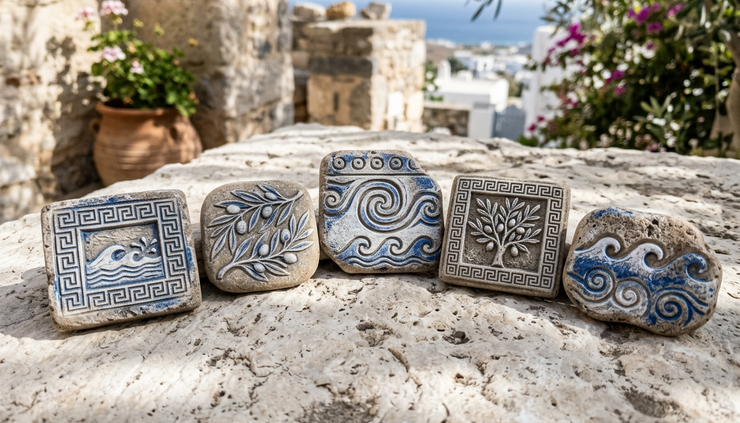
That is the strength of Aegean-inspired handcrafted décor. These pieces do not need to be large to feel meaningful. Their value comes from texture, motif, and craft. A carved wave line can hint at sea routes. A meander border can echo ancient Greek ornament. A rough mineral surface can suggest weathered limestone walls in coastal settlements.
Handcrafted cultural tablets, magnets, and coasters work especially well because they are both decorative and useful. They fit into everyday spaces while carrying references to archaeology, architecture, mythology, and regional material culture. When made with care, they feel less like generic souvenirs and more like small heritage objects shaped for modern homes.
The Aegean region gives these pieces a rich visual language
The Aegean region has one of the most recognizable cultural vocabularies in the Mediterranean. It includes mainland coastal areas, Greek islands, western Anatolia, and historic sea routes that connected communities for thousands of years. This setting matters because the objects inspired by it often borrow from real sources instead of vague “ancient” styling.
Several historic traditions shape the look of Aegean-inspired tablets, magnets, and coasters:
Cycladic forms
Cycladic art, especially from the Bronze Age, is known for clean silhouettes, pale stone, and calm human figures. Even when a modern piece does not copy a figure, it may reflect the same simplicity through smooth planes and restrained lines.
Minoan marine motifs
Minoan art from Crete often used dolphins, octopuses, shells, and flowing sea life. These forms work naturally on small objects because their curves can wrap around square coasters, arched tablets, or round magnets.
Mycenaean and classical patterns
The Greek key, also called the meander, appears widely in ancient Greek design. It reads clearly even at a small scale, which makes it practical for borders and frames.
Anatolian and island craft traditions
Western Anatolia and the Aegean islands share a long history of ceramics, stonework, weaving patterns, and architectural ornament. A tablet with a rosette, a sun disk, or a geometric edge can connect to that broader craft memory.
The best pieces use these references with restraint. A coaster does not need ten symbols at once. One strong border, one carved olive branch, or one gently aged surface often tells the story better.
This is where Aegean Heritage Crafted Tablets Magnets and Coasters with Timeless Stone Textures become more than a category name. It describes a design approach: small handmade objects, grounded in historic motifs, finished with surfaces that feel touched by time.
Stone texture makes the craft feel grounded
Stone has a direct link to the Aegean built environment. Temples, harbor walls, village lanes, amphitheaters, fountains, and courtyard steps were often made from local stone. Marble, limestone, volcanic rock, and terracotta surfaces all carry different visual cues.
Handcrafted pieces inspired by this region often recreate that feeling through stone-like finishes rather than heavy carved blocks. Makers may use mineral-based casting compounds, ceramic bodies, gypsum blends, resin-stone mixtures, clay, or sealed cement-like materials. The exact material changes by workshop, but the visual goal is similar: a surface that looks weathered, tactile, and slightly uneven.
A convincing stone texture usually includes a few key details:
Surface detail | What it adds to the piece |
Fine pitting | Suggests limestone or aged plaster |
Soft edge wear | Makes the object feel handled and timeworn |
Mineral speckles | Adds depth without heavy color |
Matte sealing | Reduces glare and supports a natural look |
Hand-applied pigment | Creates variation from piece to piece |
These details matter because real stone is rarely flat in appearance. Even polished marble has veining. Limestone has tiny pores. Old architectural fragments often show chips, worn corners, sand-softened edges, and traces of mineral staining.
For small objects, texture also affects how the piece feels in the hand. A magnet with a lightly grained surface feels more substantial than a glossy printed one. A coaster with a sealed matte finish gives the cup a stable place to rest while still feeling handmade. A decorative tablet with shallow relief catches light differently across the day.
The craft challenge is balance. Too little texture can look flat. Too much can make a coaster hard to clean or a magnet visually crowded. Good makers control depth, edge softness, and surface sealing so the item remains useful.
Historic motifs work best when they serve the object
A motif is not just decoration. On small cultural objects, it gives the piece its identity. The Aegean region offers many motifs that suit tablets, magnets, and coasters because they are readable at a compact size.
The meander border is one of the most adaptable. It can frame a square coaster, run along the lower edge of a tablet, or form a circular rhythm around a magnet. Its repeated right angles give structure without taking over the design.
The wave pattern is another natural fit. The Aegean Sea shaped trade, migration, food, mythology, and settlement patterns. A carved wave line can carry that history in a simple form. It also softens a composition when paired with geometric borders.
The olive branch carries agricultural and cultural meaning across the Mediterranean. Olive trees have been cultivated in the region for thousands of years, and their leaves are easy to recognize in low relief. A tablet with an olive branch can feel calm and domestic, especially in kitchens and dining areas.
The rosette appears in many ancient Mediterranean decorative systems. It can suggest sun, flower, or sacred ornament depending on context. On magnets and coasters, a central rosette gives the maker a strong focal point.
Marine subjects such as dolphins, shells, octopuses, and fish connect more directly to island life and Minoan visual culture. They work best when stylized rather than overly detailed. A clean dolphin silhouette or a simple shell relief often ages better visually than a highly literal scene.
There is also room for architectural cues:
Arched doorways from island villages
Column fragments and fluted edges
Mosaic-inspired borders
Amphora shapes
Fragment-like tablets with broken-stone edges
The key is proportion. On a coaster, the main design should leave enough flat space for a glass. On a magnet, the silhouette should remain strong from a few feet away. On a tablet, the motif can be more detailed because the piece is meant for slower viewing.

Tablets, magnets, and coasters each tell the story differently
The same Aegean motif changes depending on the object. A tablet, magnet, and coaster may share a style, but each has a different role in the home.
Crafted tablets bring heritage into display spaces
A decorative tablet acts like a small relief panel. It can stand on a shelf, lean against a wall, sit in a bookcase, or become part of a ceramic and stone grouping. Because it is not handled as often as a coaster or magnet, a tablet can carry deeper carving, layered pigment, or a more complex scene.
Common tablet forms include rectangular plaques, arched panels, fragment-like slabs, and small wall-hanging pieces. The strongest versions often look like recovered architectural details, not because they pretend to be antiques, but because they use the visual grammar of age: softened corners, mineral tones, uneven surfaces, and low relief.
A tablet inspired by a harbor scene might show three simple elements: a wave line, a small amphora, and a border pattern. That is enough to suggest trade, sea travel, and craft without turning the piece into a crowded postcard.
Magnets make cultural details part of daily routines
Magnets are often treated as casual souvenirs, but handmade stone-textured magnets can feel more considered. Their small size invites clear symbols. A single shell, sun disk, blue door, olive sprig, or Greek key border can work well.
The practical detail is weight. A magnet should have enough strength for its material. If the piece is made from a dense stone-like compound, the magnet backing needs enough hold for a refrigerator or metal board. A well-made magnet should sit flat, avoid scratching surfaces, and keep its edges sealed.
Handmade variation suits magnets especially well. A set of four may share the same mold but differ in pigment tone, patina, or edge wear. That variation is part of the appeal. It shows the hand of the maker.
Coasters combine craft with utility
Coasters invite touch more than the other pieces. They need to be attractive, stable, sealed, and easy to wipe clean. A stone texture can give them character, but the surface should still support cups and glasses safely.
Good Aegean-inspired coasters often use motifs around the edges rather than in the center. A border pattern leaves the middle more functional. Round coasters may use a wave ring, while square ones may use a meander frame. Neutral stone tones, off-white, sand, soft gray, and muted terracotta, make them easy to place on wood, marble, glass, or linen-covered tables.
A practical coaster set might include:
Four pieces with the same border and slight color differences
A mix of sea, olive, and geometric motifs in one palette
Felt, cork, or smooth backing to protect surfaces
A sealed top coat suited to light moisture
The craft must respect the function. A beautiful coaster that stains easily or rocks under a glass will not stay in use.
Handmade artistry depends on process, not just appearance
The handmade character of these pieces comes from process. Even when a maker uses a mold for consistency, the final object can still involve hand-pouring, sanding, carving, painting, sealing, and finishing.
A typical small-batch process may include:
Designing the motif
The maker sketches a form that can survive at small scale. Thin lines, fragile corners, and overly fine details may break or disappear.
Preparing the form
This might involve carving a master, building a mold, pressing clay, or casting a mineral mixture.
Refining the surface
Edges are sanded, relief details are cleaned, and the surface receives controlled irregularity.
Applying color and patina
Pigments may be rubbed into recessed areas, dry-brushed over raised details, or layered to imitate mineral aging.
Sealing and backing
Coasters need moisture resistance. Magnets need secure backing. Tablets may need hanging hardware or a stable base.
This process explains why two handmade pieces rarely match exactly. A small air pocket, a pigment shift, or a sanded edge can give each object a distinct character. That difference should look intentional and well finished, not careless.
There is a clear line between handmade variation and poor construction. Good pieces should have clean backs, stable shapes, safe edges, and sealed surfaces. Magnets should hold. Coasters should sit flat. Tablets should display securely.
The craft is strongest when the maker respects both the old reference and the modern use.
Styling Aegean stone-textured pieces at home
Aegean-inspired tablets, magnets, and coasters work best when placed with materials that share their quiet, natural quality. They pair well with linen, wood, matte ceramics, woven trays, clear glass, and plants such as rosemary, olive, thyme, or bay.
For a shelf, a stone-textured tablet can sit beside a small ceramic vessel and a stack of books. Keep the grouping simple so the relief remains visible. A tablet with a wave motif looks good near blue-gray ceramics, while an olive branch design pairs well with warm woods and cream tones.
For a kitchen, magnets can create a subtle cultural detail without visual clutter. A small set in related tones looks more cohesive than many unrelated pieces. Choose motifs that connect through shape or color, such as all marine forms or all geometric borders.
For dining areas, coasters can support the wider table setting. Sand-colored coasters with meander edges pair well with white plates and stainless flatware. Terracotta-toned coasters can warm a table with wood or earthenware.
Care is simple for most sealed pieces, though it depends on the maker’s material. As a general rule:
Wipe with a soft damp cloth.
Avoid soaking stone-textured pieces unless the maker says they are waterproof.
Do not use harsh scouring pads on patinated surfaces.
Lift coasters to clean underneath after use with cold drinks.
Keep decorative tablets away from constant outdoor moisture unless made for exterior use.
These habits protect the finish and help the surface age gracefully.
Why these small objects endure
Aegean-inspired handcrafted tablets, magnets, and coasters last in memory because they connect use, place, and story. They borrow from real cultural forms, but they belong to the present. A coaster still holds a cup. A magnet still keeps a note in place. A tablet still gives a shelf a point of focus.
Their appeal comes from the meeting of three things: stone-like texture, historic motif, and visible handwork. Remove one, and the object becomes less compelling. Texture gives it weight. Motif gives it meaning. Handwork gives it presence.
The best pieces do not shout for attention. They reward a closer look. A softened corner, a carved border, a trace of blue pigment, or a raised olive leaf can hold more feeling than a larger object with less care.
That is the quiet power of this category. It turns everyday items into small carriers of Aegean heritage, shaped by tradition, made by hand, and designed to live naturally in the spaces people use every day.
Yorumlar